

When Thomas Noui and Victor Robin named their studio Zbeul, they were being honest with you. The word derives from an Arabic root that translates, roughly, to rubbish — or more generously, something teeming with unruly life. It is not the name of a studio that wants to reassure you. It is the name of a studio that wants to make you look twice, and then a third time, at an object you thought you understood.
Zbeul Studio is a Paris-based practice founded in 2023, and it has spent its short existence doing something most contemporary furniture design actively avoids: treating the historical record not as a mood board but as a methodology. Noui, who trained at École Camondo and won the Monnaie de Paris Prize, and Robin, a cabinetmaker educated at La Bonne Graine, share a conviction that design is a form of archaeology — that the objects we make carry forward the gestures and social arrangements of every object that came before them. What distinguishes Zbeul from studios that mine the past for surface texture is the seriousness with which they pursue that conviction through material.
Furniture as Exoskeleton
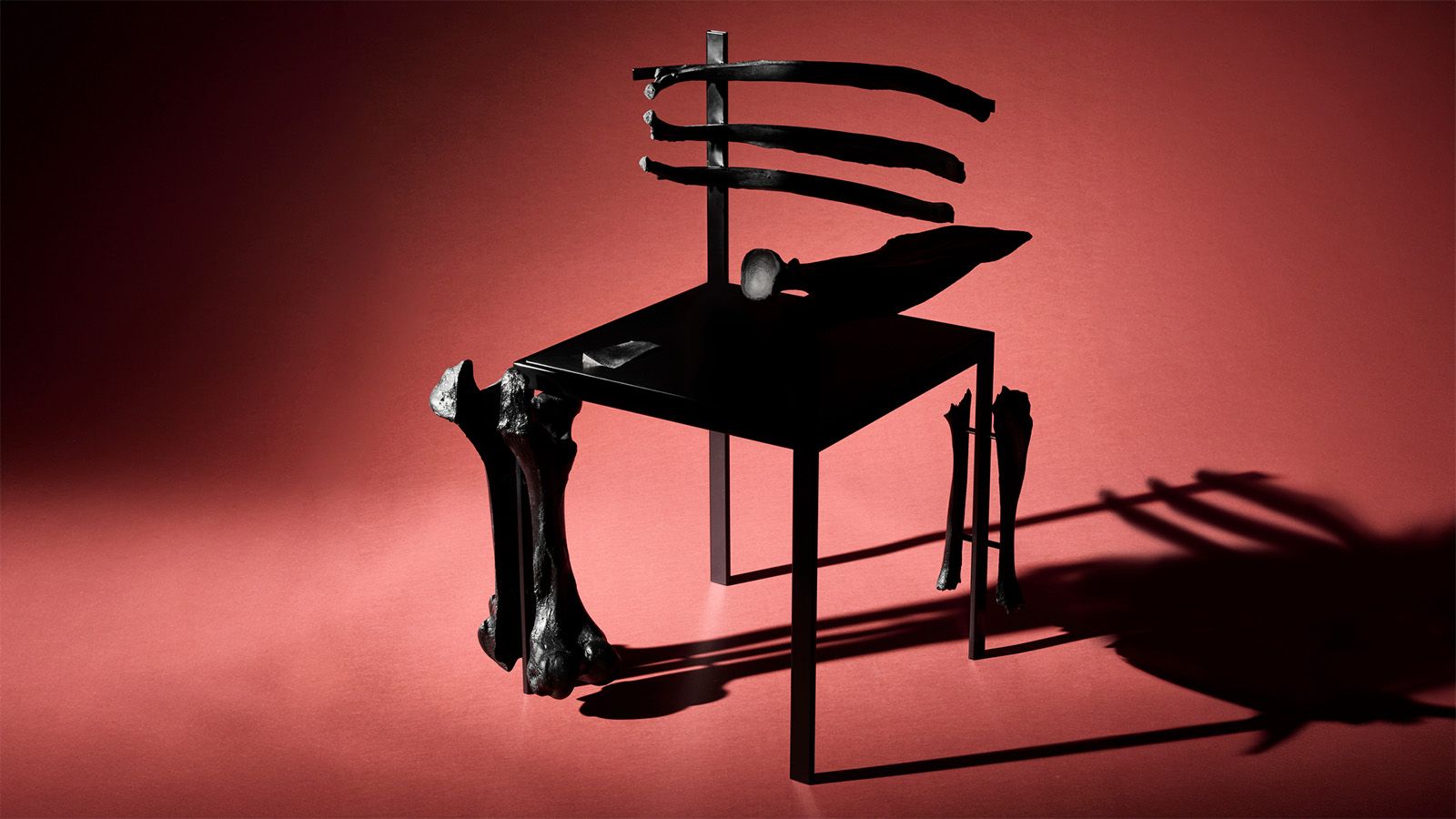
The piece that first drew significant attention to the studio was the Archeologia Chair, built from animal bone. Not bone as decorative inlay, not bone as reference or metaphor — bone as primary structural material. Noui has described the logic plainly: they found it interesting to work with skeletal elements to create a chair, an object that acts as an exoskeleton by structuring the body. There is a clean philosophical coherence here that is easy to miss if you come to the piece expecting provocation for its own sake. A chair is, in fact, a support system for the human skeleton. Bone holds the body up from within; the chair holds it up from without. The choice of material is not shock value. It is the argument made visible.
To achieve the finish, the duo adapted traditional wood-staining techniques to animal bone, building toward a deep black surface that accentuates the microscopic detail of the material — the fine channels and grain patterns that become, under this treatment, almost illegible as biological matter. The result sits somewhere between a clinical specimen and a ritual object, which is precisely where Zbeul intends to operate. They have said explicitly that they play with the boundaries between beauty and repulsion. That tension is not incidental to the work; it is the engine of it.
From Bone to Rope: The Cordes Collection
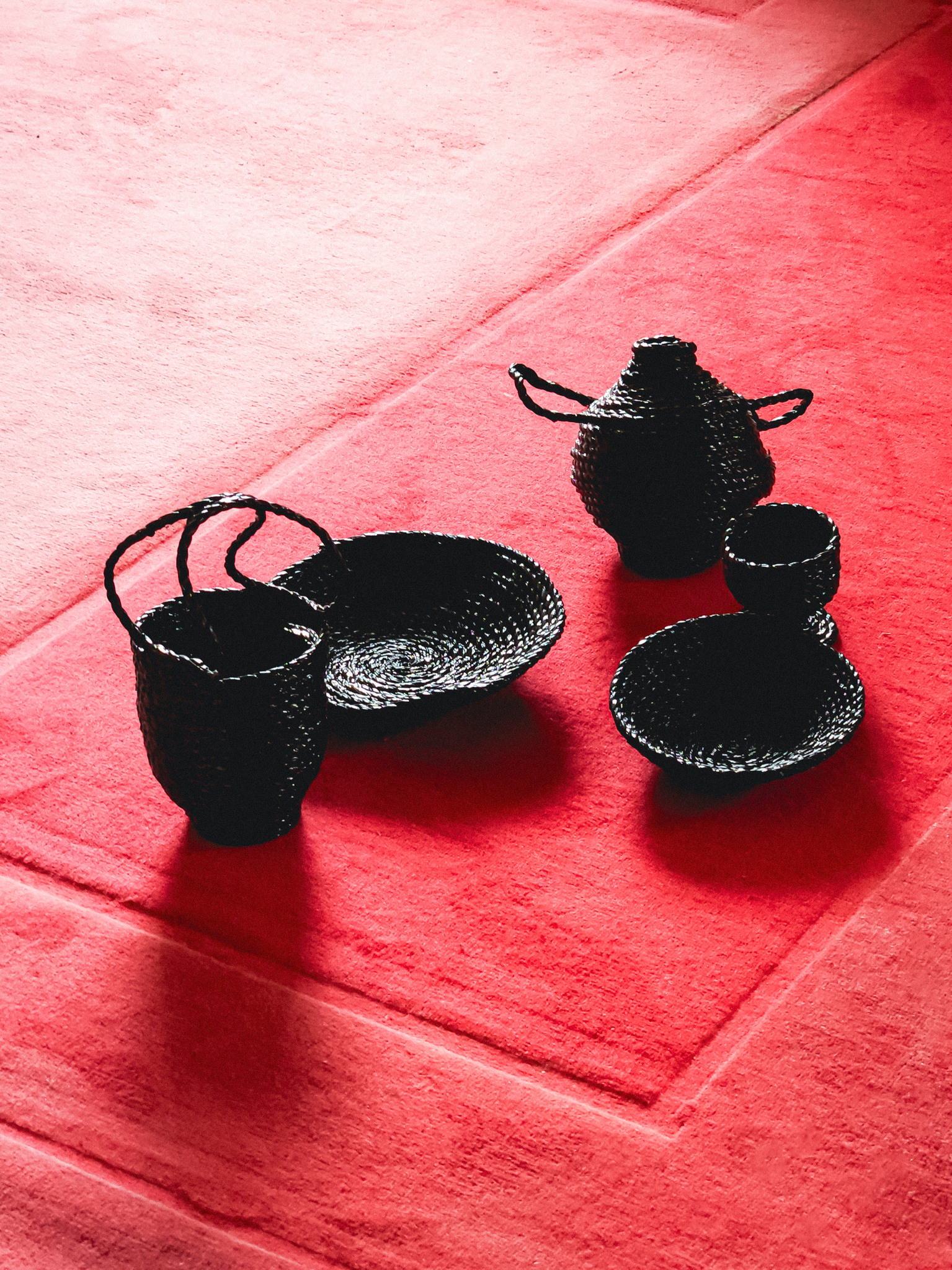
For their Cordes collection, shown at Paris Design Week 2025 and represented by Galerie BSL, Noui and Robin shifted material while deepening the same inquiry. The five pieces — a jar, vase, amphora, bowl, and related forms drawn from antique archetypes — are built from hemp rope, pine resin, and lacquer. The process was prompted by the traditional Japanese technique of applying urushi lacquer to rice ropes, a discipline the duo encountered and then set about transposing into a specifically European material language, substituting Martin varnish and pine tar for their Asian counterparts.
The resulting objects occupy an interesting interpretive space. They look, at a glance, like ancient vessels — the Stamnos and Pelike shapes in particular carry the weight of classical Greek pottery, the kind of thing you encounter behind glass in a museum. But the surfaces have an unusual organic quality, the coiled rope preserved in its structure beneath the lacquer, giving each piece a subtle texture that no clay or fired ceramic could produce. The conceptual pitch Zbeul makes for this work is that they are probing the possible filiations between craft, design, and archaeology — opening what they call a space of dialogue between history and uchronia. Uchronia: an imagined alternative history, a past that did not happen but could have. Objects that look like they were excavated from a civilization that never existed.
This is not a gimmick. It is a serious position about what design objects are for and how they operate in time. Most design is optimistic about its moment — it wants to look current, to feel fresh, to signal the present tense. Zbeul’s work is explicitly oriented toward duration and retrieval. They design objects with the intention that they become future relics. That is a genuinely different ambition, and it produces genuinely different objects.

Why This Matters Now
Wallpaper* included Zbeul Studio in its Future Icons for 2026, the magazine’s annual selection of emerging designers worth following. The recognition is well-placed, and it arrives at a moment when the broader conversation in design is reaching for exactly the values the studio embodies. The dominant trend language of 2026 is centered on materials with history, tactile surfaces, and what various forecasters are calling modern heritage — a desire to ground contemporary design in something that feels earned rather than invented.
Zbeul addresses that appetite without softening it into nostalgia. Their work does not feel warm in the way a linen sofa or an exposed beam feels warm. It feels old in a more unsettling register — the kind of old that makes you think about time moving in both directions. That is harder to achieve than it sounds, and it is harder to live with, which is probably why it will age well.
The studio is represented by Galerie BSL in Paris, which also shows work by designers including Ronan and Erwan Bouroullec, Studio Swine, and Formafantasma — a calibration that tells you something about where Zbeul sits in the field. This is not emerging designer in the sense of talented graduate showing promising work. This is a studio that arrived with a coherent intellectual position and the technical ability to execute it, which is a much rarer combination.
What to Seek Out
If you want to encounter the work, Galerie BSL is the primary point of access. The Cordes collection pieces — the Stamnos and Pelike vessels in particular — are the most approachable entry point, formally beautiful in a way that does not require you to engage the conceptual scaffolding, though the scaffolding rewards attention. The Archeologia Chair is harder to find and harder to look at, which is part of the point.
For a wider frame on the kind of thinking Zbeul is working within, the 2020 Phaidon volume Animal edited by Catherine Ince provides a rigorous survey of design practices that engage the non-human material world. It is not a direct companion to Zbeul’s work, but it offers context for why the territory they are working in is philosophically richer than it might first appear.
Zbeul Studio is making objects that want to be misread as old. That is a strange ambition in a design world that mostly wants to be misread as new. Pay attention to them — not because they are about to be everywhere, but because the best design rarely is.