

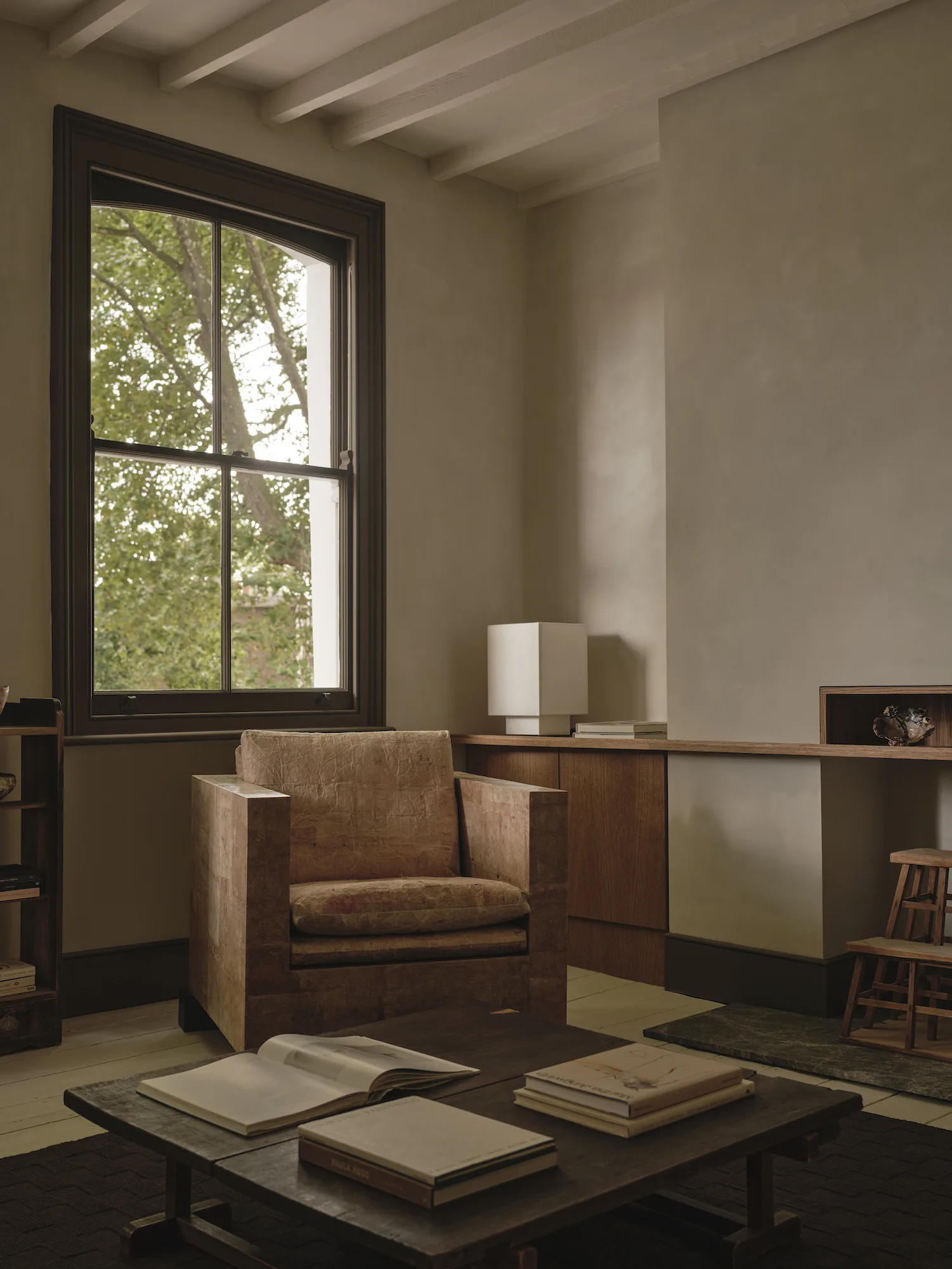
There is a particular kind of restraint that only comes from knowing exactly what you are doing. It is not emptiness. It is not minimalism practiced as ideology. It is the quality of a space that has been thought through at every joint and seam, where what is left out matters as much as what remains. Heion House, a Late-Georgian terrace in north London renovated by Studio Hagen Hall, has that quality in abundance. Encountering it, you get the sense that the designer made every decision twice: once to arrive at the answer, once to confirm it.
Studio Hagen Hall was founded in 2021 by Louis Hagen Hall, and in the years since it has built a quiet but unmistakable reputation across London’s residential and hospitality landscape. The studio works across architecture, interiors, furniture, and textiles, and that multidisciplinary range shows in the way Hagen Hall approaches a project: not as a decorator arriving with a mood board, but as someone who understands the full material logic of a space from structure to surface. Heion House is the clearest demonstration of that thinking to date, and it arrived in early 2026 to the kind of sustained attention that most emerging studios spend years chasing.

Build Less, Build Better
The project begins with a particular kind of discipline. Rather than opening the Georgian terrace up into the seamless open-plan arrangement that dominates a certain tier of London renovation, Hagen Hall moved in the opposite direction. “Rather than opening up the house, we worked to make each space feel unique,” he has said, “more obviously through its use and bespoke joinery to match, but also by contrasting lighter open spaces with moodier, more enclosed spaces.” It is a counter-intuitive position in a market that has spent a decade knocking down walls, and it produces something rarer than the open-plan: rooms that feel like rooms.
The house spans three storeys, and the reconfiguration rethinks which activities belong where. The primary bedroom was moved to the upper-ground floor to capture light and views over the square. The lower ground floor holds the kitchen, a sunken dining room, and a snug opening onto a front courtyard. A multifunctional room at the rear does duty as art studio, study, guest room, and, perhaps most remarkably, a dedicated space for the owner’s CD collection, a wall-length storage system built specifically for it. That kind of specificity, designing for the particulars of actual lives rather than abstract lifestyles, runs through every decision in the house.
The Threshold as Design Statement
One of the first things you encounter at Heion House is a genkan. The traditional Japanese entryway, the transitional step where shoes are removed before entering the home, is not a stylistic flourish lifted from a design mood board. The clients spent significant time living in Japan, and their collection of Japanese ceramics, antique furniture, and self-made objects is embedded throughout the house. The genkan is an acknowledgment of that history, and also a piece of spatial logic: it marks a threshold, creates a moment of pause, and signals that you are entering a different register of space. It is the kind of detail that earns its place not by looking good in photographs but by changing how you move through a building.
Hagen Hall has spoken about the relationship between Modernist and Japanese design principles in a way that clarifies why the combination works here without feeling like fusion for its own sake. “Modernism brings a kind of spatial and functional rigour,” he said, “while Japanese principles introduce warmth and sensitivity to nature. Together they create a balanced approach.” In practice, this means smoked-oak joinery, lime-washed walls, steel and brass fixtures, and a palette of materials chosen specifically because they will patina rather than age badly. The house is designed to look better in ten years than it does now, which is a bet that only careful material thinking can make.

Joinery as Architecture
Bespoke joinery does a significant amount of structural and atmospheric work in the house. The kitchen on the lower ground floor is defined by custom oak cabinetry and stainless-steel countertops, with appliances concealed to maintain the coherence of the surfaces. The flooring continues out through the kitchen into the garden courtyard, dissolving the boundary between inside and out in a way that works spatially rather than through glass or glazing alone. A glass cabinet set beneath the restored staircase provides display space for the clients’ ceramics collection, framing it without making it precious. Upstairs, a custom oak bed anchors the primary bedroom with the kind of presence that only comes from something made for the room.
What is consistent throughout is the use of movable openings: wall-length panels that can separate or connect adjoining rooms depending on how the day is going. This is a practical solution to the rhythms of a house lived in by two people over time, but it is also a spatial one. The rooms remain rooms when the panels are closed. When open, the house breathes differently. “They provide the ability to separate or connect adjoining rooms,” Hagen Hall says, “enabling privacy or opening up views and social interaction.” It sounds simple, and it is, which is precisely the point.
Heritage Without Nostalgia
One of the persistent challenges of working within a heritage-listed building in London is the negotiation between what must be preserved and what can be changed. Heion House handles this with unusual confidence. The Georgian staircase has been restored. The original proportions and volumes of the rooms are respected. But the interventions are clearly of the present: the joinery, the materials, the threshold moments, the bespoke furniture. There is no pastiche, no attempt to make the new things look old, and no apologetic modernism that treats the heritage fabric as a constraint to be worked around. The old and the new are in conversation, and neither is performing for the other.
This is harder to achieve than it looks. Conservation areas in London impose real limits, and the temptation in premium residential design is either to strip everything back to a blank canvas or to pile on period detail. Hagen Hall does neither. He works with the bones of the building at a level of structural seriousness, and then introduces a layer of material thinking that is entirely contemporary in its sensibility. The result is a house that feels settled without feeling static.

Why Studio Hagen Hall Is Worth Watching
Studio Hagen Hall was named among the emerging studios to watch in Homes and Gardens’ Next in Design 2026 program, and the Heion House project makes a compelling case for why. The studio is doing something distinct from the dominant modes of British residential design right now. It is not the pared-back Scandi-influenced minimalism that swept through a certain tier of London interiors over the past decade. It is not the layered eclecticism that has come in response. It is something more considered: a practice built on research, craft, and a genuine understanding of how materials behave over time.
What Hagen Hall seems to understand, and what Heion House demonstrates clearly, is that good design is not primarily about what things look like. It is about how spaces work, how they feel over years of use, and whether the decisions made at the beginning of a project hold up under the weight of actual life. The CD wall, the genkan, the movable panels, the stainless-steel kitchen made to conceal rather than display: these are all design decisions that serve someone’s specific life, not a generic idea of good living. That orientation, toward the particular rather than the generic, is what distinguishes a studio doing work worth paying attention to from one producing work that merely looks good in photographs.
Heion House photographs beautifully, by the way. Felix Speller’s images have a quality of light and stillness that matches the building perfectly. But the photographs feel like a record of something real rather than a staging for a shoot, which is not always the case with residential design at this level. That gap between how a space is designed and how it is actually lived in is where most design fails. At Heion House, it is where the design succeeds.