

Most of us learned brutalism as a European story. It begins with Le Corbusier pouring raw concrete in Marseille, passes through a polemical essay or two in 1950s London, and ends, depending on who is telling it, with either a council estate facing the wrecking ball or a moody black-and-white photo racking up likes on Instagram. Asia appears in that story, if at all, as a footnote: Chandigarh, maybe Kenzo Tange, then back to the Barbican.
Brutalist Asia, the new hardcover from the London publisher Blue Crow Media, is a 304-page argument that the footnote was the main event all along. Edited by the London-based architect Bob Pang and Blue Crow founder Derek Lamberton, it surveys 140 buildings across 28 countries, from Japan to Lebanon, with more than 150 photographs and eight original essays. It is, by the publisher’s own description, the first major survey of brutalist architecture across the entire continent. That claim, if anything, undersells what the book does, which is to change the question you ask of a concrete building.
A Brutalist Architecture Book That Refuses the Imported-Style Story
The easy version of this book would have been a world tour of Le Corbusier’s influence. The Palace of Assembly in Chandigarh is here, and so is Paul Rudolph, but the editors are plainly more interested in the people who took the language of raw concrete and bent it to their own climates, budgets, and politics. As Jonathan Bell put it in his review for Wallpaper*, the book presents Asian brutalism “from a local point of view, rather than as a continuation of an imported style.”
That framing pays off in the details. Consider the Round Building at Mahidol University’s Faculty of Science in Thailand, completed in 1968 by Amorn Srivong. In a selection of favorites Pang shared with Dezeen, he notes that Amorn had no formal architectural training at all. He worked as a labourer on construction sites, became a draftsman at a structural engineer’s office, and was designing university buildings with daring cantilevers by the 1960s. That is not a borrowed style. It is someone learning concrete with his hands and pushing it further than the textbooks suggested.
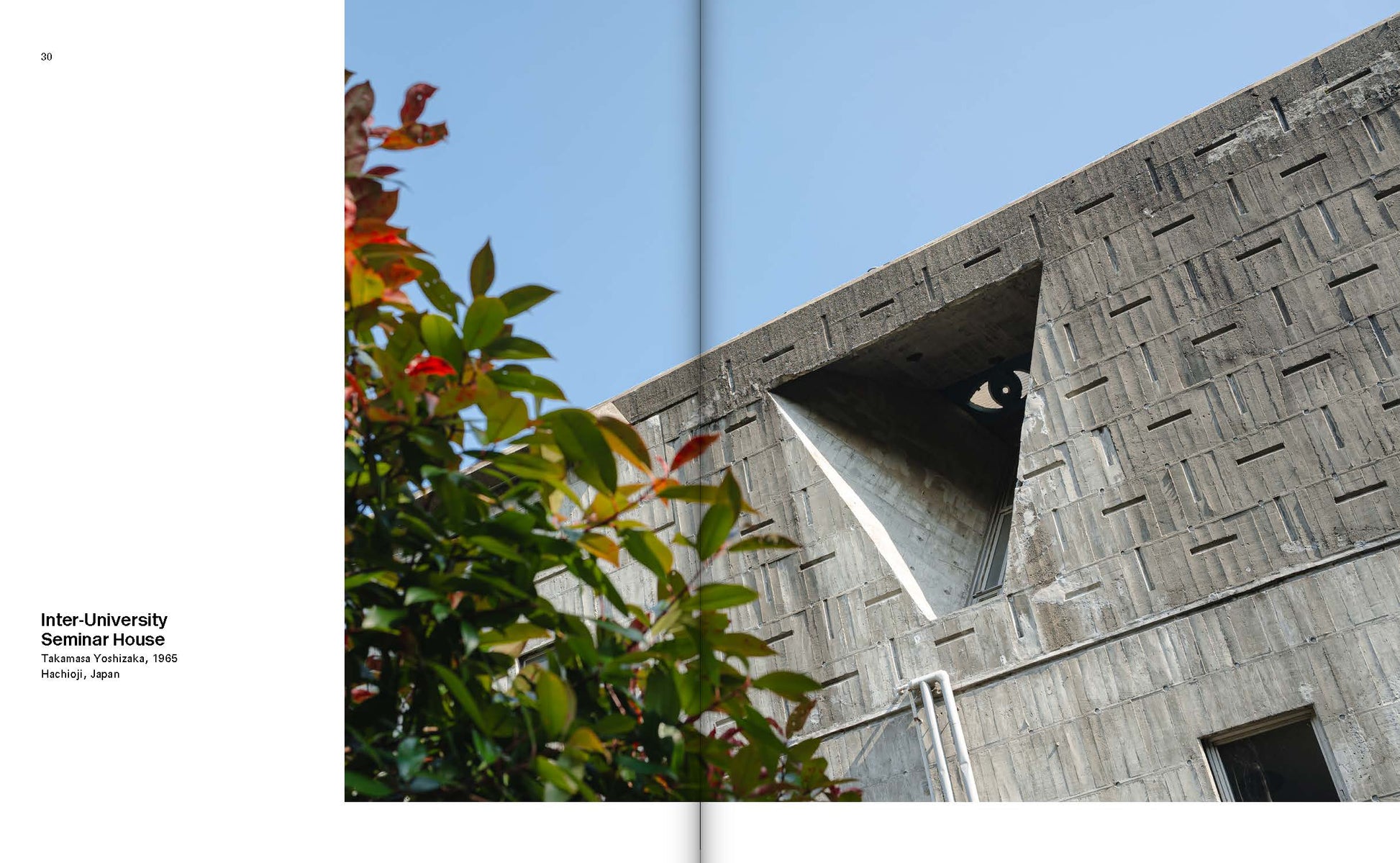
Or take Kim Swoo-geun’s Kyungdong Presbyterian Church in Seoul, from 1981, whose vertical masses abstract the gesture of two hands pressed together in prayer. Or Takamasa Yoshizaka’s Inter-University Seminar House in Hachioji, Tokyo, a 1965 academic complex with an inverted pyramid for a main hall. Yoshizaka trained in Le Corbusier’s Paris studio and translated his texts into Japanese, yet the building he made is unmistakably his own, and Pang notes it remains in use today. That last detail matters more than it seems.
How Brutalism Actually Works in Heat, Rain, and Shade
Here is where the book becomes useful to anyone who thinks about rooms, not just buildings. In Europe, brutalism is often discussed as an aesthetic or a political position: honesty of material, the welfare state cast in concrete. In much of Asia, it reads first as a climate strategy.
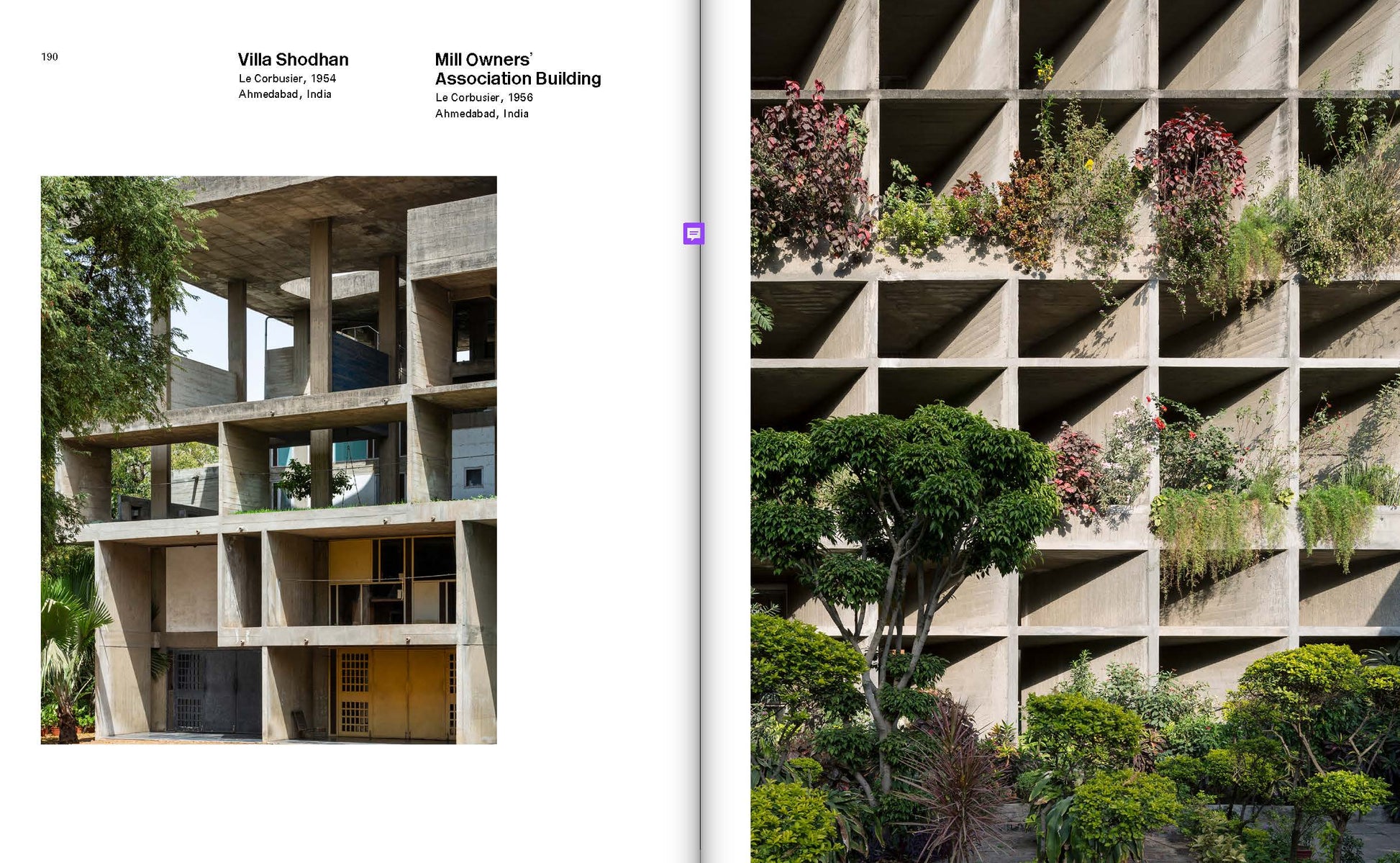
Look at the spread above from Ahmedabad. Those deep concrete grids are not decoration. A brise-soleil, the projecting lattice of fins and frames you see on so many tropical modernist buildings, puts the glass in shadow during the hottest hours while letting air and indirect light through. Thick concrete has thermal mass, which means it absorbs heat slowly during the day and releases it slowly at night, flattening the temperature swings inside. Overhangs carry monsoon rain away from openings. And look at what has happened over seventy years: plants have moved into the grid. The building has become a trellis. Brutalism in a humid climate turns out to be a frame for something softer than itself, which is the opposite of the cold, forbidding reputation the style carries in the West.
The publisher’s description is explicit on this point, saying the book explores how architects across Asia reinterpreted brutalism “in response to local climates, materials, cultures and political conditions.”
If you live with concrete, or you are considering it for a kitchen, a stair, or a whole house, this is the lesson to take home. Raw material performs best when it is doing a job. A concrete wall that shades, stores heat, or frames a view earns its weight. A concrete wall that is there only because it photographs well tends to feel heavy and a bit cold, and the people who live with it notice. The best interiors in this book, like the swirling spiral stair in the Chang Ching Yu Memorial Library at Chung Yuan Christian University in Taiwan, pair the material with warm timber, terracotta floors, daylight, and greenery. That pairing is not a compromise. It is how the material was meant to be used.
The Buildings We Are Losing
The book is not only a celebration. Several of the eight essays, written by architects and researchers including Christele Harrouk, Bhawna Dandona, Pinai Sirikiatikul, Caryn Paredes-Santillan, Kyung Taek Lee, John Barr, and the duo of Soroush Mohajery and Amirhosein Rad, read as field reports from a slow-moving heritage crisis.
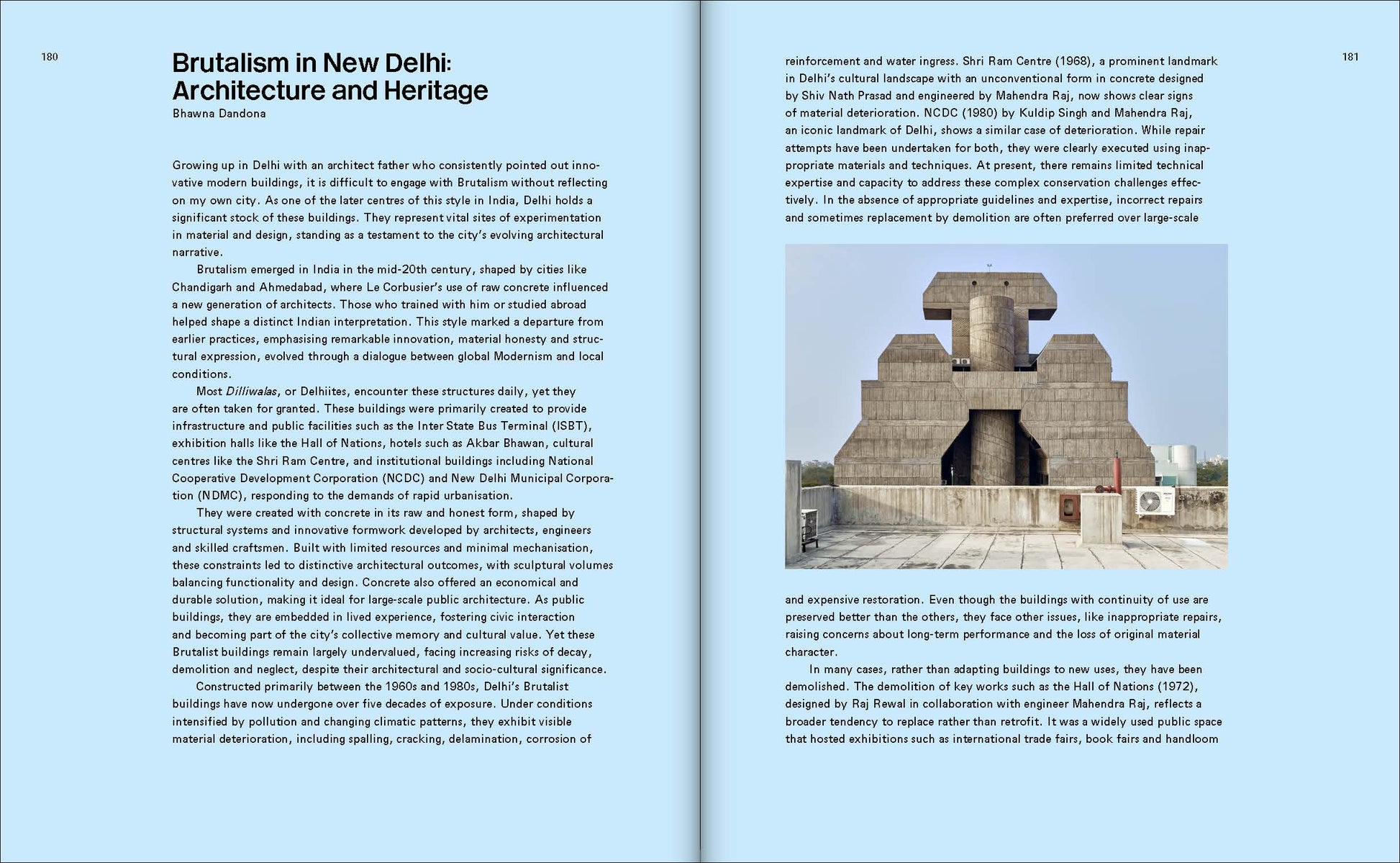
Dandona’s essay on New Delhi is the one I keep returning to. She describes a city full of concrete landmarks, from bus terminals and exhibition halls to hotels and civic buildings, that residents pass every day and take for granted. Many now show spalling, cracking, and delamination after decades of pollution and weather. When repairs happen, she writes, they are often done with the wrong materials and techniques, and demolition is frequently preferred over careful restoration. Her example is Raj Rewal’s Hall of Nations, engineered with Mahendra Raj and completed in 1972, which was torn down in 2017 despite international protest. It explains why a volume like this matters. Documentation is often the first step toward protection, and sometimes the only record that survives.
The flip side of that warning is the Interdesign Building in Beirut by Khalil Khoury, which Pang notes took 23 years to complete because of Lebanon’s civil war and has never been in full use. It is one of the most striking buildings in the book, a tower that looks carved rather than built, and it carries a whole national history in its unfinished state.
The Object Itself
As a physical book, Brutalist Asia continues Blue Crow Media’s run of regional surveys, following its earlier volumes on London, Paris, and Berlin, and it shares their discipline. It is a hardcover printed on premium uncoated paper, and judging by the sample spreads the publisher has released, the design is measured, with a typographic restraint that lets the photography do the talking. The spreads alternate full-bleed images with generous white space, so the buildings are given room to be strange. It is also a manageable size at 260 by 210 millimetres, which means it is a book you will actually open rather than one that sits on a coffee table to signal good taste.
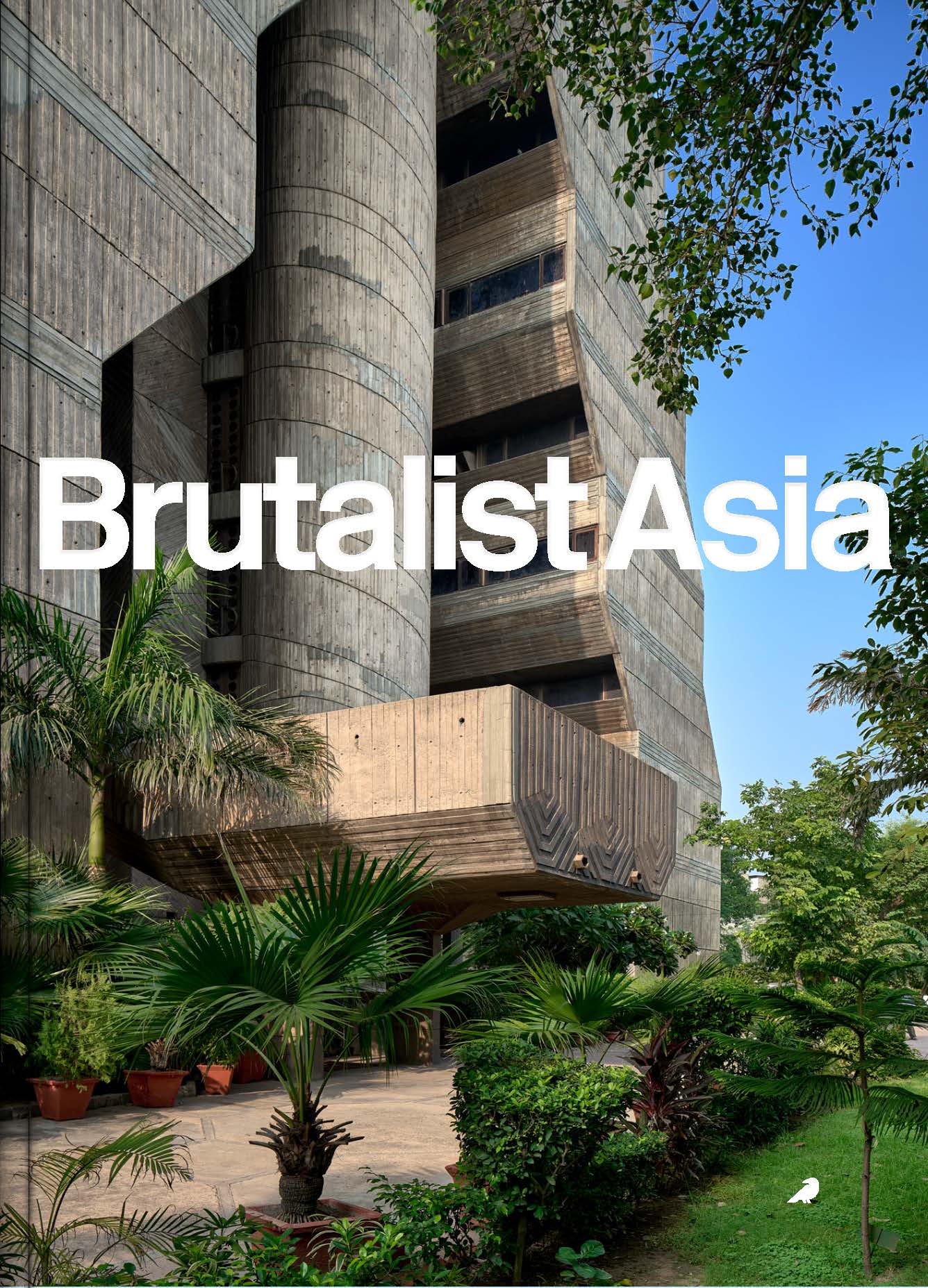
Even the cover makes the book’s argument. A board-marked concrete tower, its surfaces striated by the timber forms it was poured into, rises out of a garden of palms under a blue sky. It is a long way from the grey London drizzle most of us picture when we hear the word brutalist, and that is entirely the point.
If I have a reservation, it is one of scope. Twenty-eight countries and 140 buildings in 304 pages means some entries are necessarily brief, and readers who fall for a particular region will want to go deeper. Fortunately, the regional essays give you a place to start, and Pang’s own earlier work on Hong Kong, including Blue Crow’s Brutalist Hong Kong Map, is a natural next step.
Why It Belongs on Your Shelf
The best design books do more than show you beautiful things. They retrain your eye so that you walk out of the house and see differently. Brutalist Asia does that. Spend time with it and you start noticing shade more than surface, asking what a heavy wall was actually doing, and wondering how many unremarkable concrete buildings I pass every day that someone, somewhere, is trying to save.
Brutalist Asia is available directly from Blue Crow Media for £45 and in the United States through Barnes & Noble for $60. At the time of writing, the publisher’s page listed it as sold out and Barnes & Noble showed it out of stock online, so check both, along with your local independent bookshop. If you see it, buy it. Concrete lasts a long time. First printings of good architecture books do not.